

Figma Config 2026: Signs of Transformation at the Intersection of Design and AI
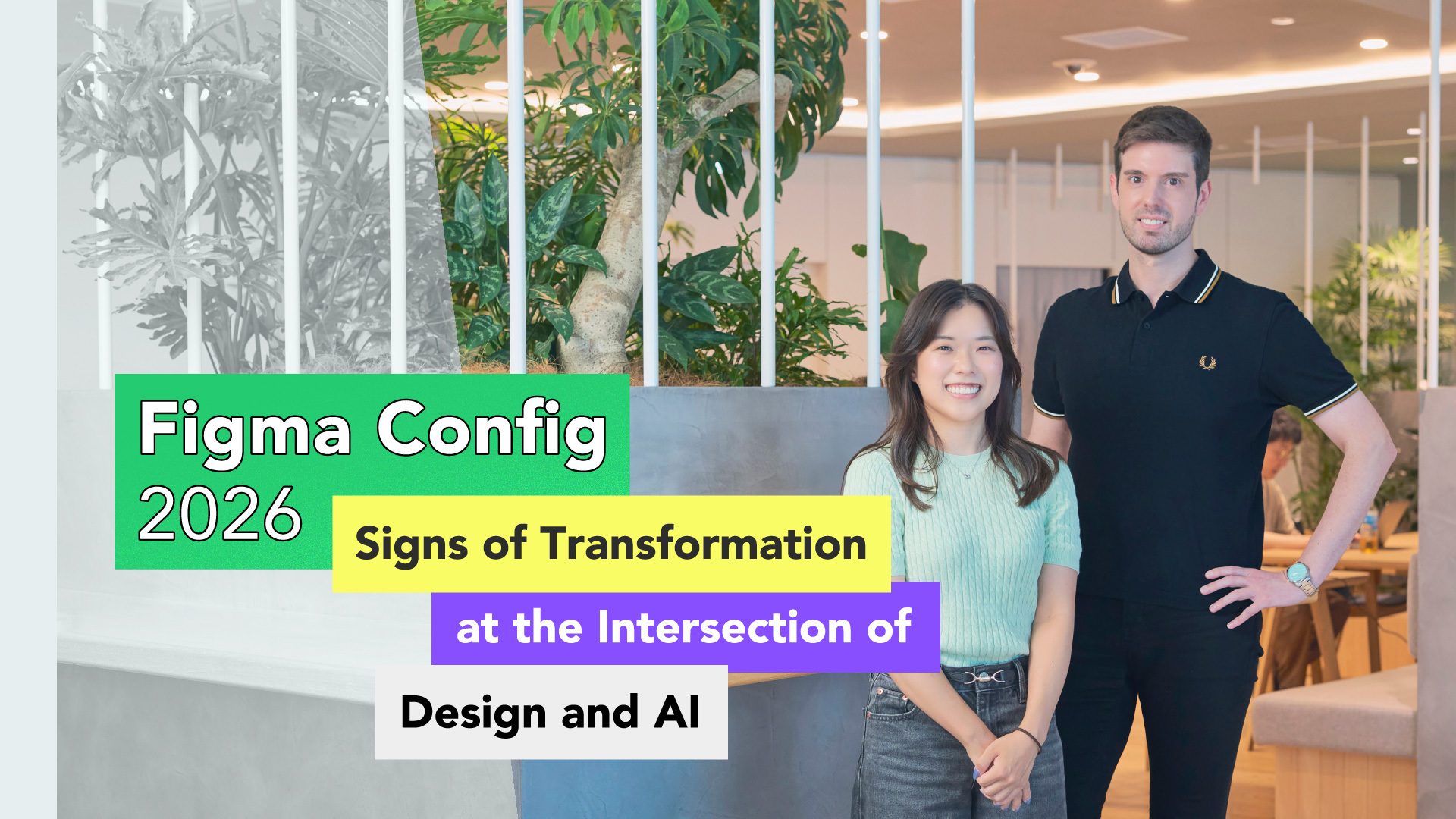
In June, Figma Config 2026-Figma’s largest annual conference-was held in San Francisco, bringing together over 10,000 attendees, including designers, engineers, and product managers from around the world. In an era where design and AI intersect and the way we build products is beginning to shift, attending in person yielded unique insights. Antoine Desmeliers, a Product Designer involved in UI design, and Natsumi Kuribayashi, a UX Designer, reflect on the changes they sensed at Figma Config 2026 from their respective domains of expertise.
Figma Config 2026: A Turning Point in Design Observed on the Ground
—Could you first tell us about Figma and its conference, "Figma Config"?
Antoine Desmeliers: Figma is a collaborative tool used to design and build digital products, such as websites and mobile applications. Its defining feature is that team members across different disciplines-such as designers, engineers, and product managers-can simultaneously edit the same file directly within a web browser, making it a shared language for product teams worldwide. In Japan, adoption has expanded rapidly in recent years, firmly establishing Figma as the standard design and product development platform.
Today, it is further evolving into an integrated production environment powered by AI. As AI agents within Figma handle repetitive tasks, we can more easily focus on high-value work-such as designing complex user journeys, creating intuitive product experiences, shaping strategy, and establishing global design governance.
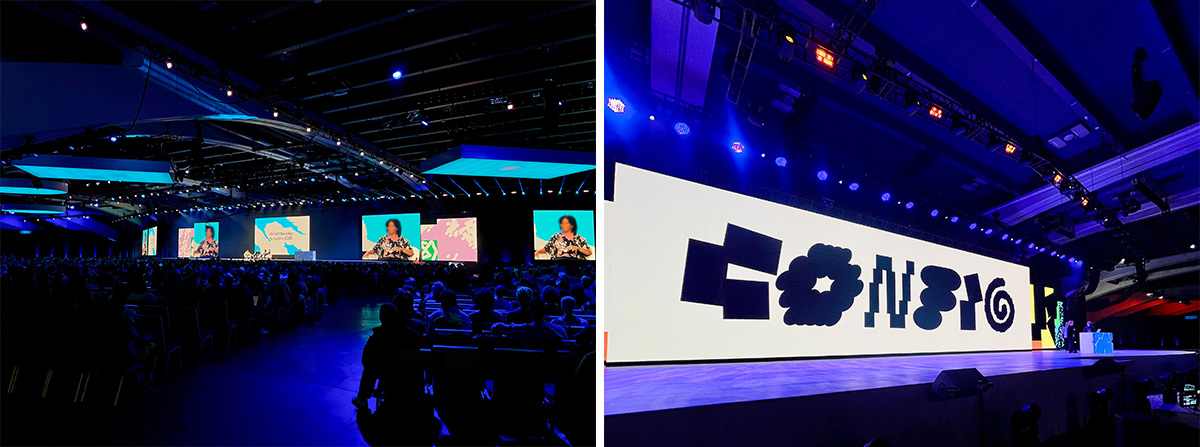
Natsumi Kuribayashi: "Figma Config" is the largest annual conference hosted by Figma. It attracts global attention not only as a stage for revealing new product features, but also as a forum where global practitioners gather to debate the future of digital product development. This year’s event was held at the Moscone Center in San Francisco.
—While sessions are available to watch online, what made you choose to attend in person?
Kuribayashi: The primary reason for attending in person is to gain insights you can't get from session recordings. Being there allows us to engage in direct dialogue with Figma’s product teams and engineers, diving deep into discussions about the design philosophies behind new features and their future trajectory. In partner-exclusive sessions, we also gain concrete insights into common pitfalls during implementation and key operational considerations, allowing us to translate announcements into real-world practice. Furthermore, attending Config presents a vital opportunity to bring back advanced global approaches early, elevating our entire organization's capabilities.
Another crucial aspect is peer networking. Talking with members from various companies between sessions enables us to discuss specific challenges and practical approaches such as how to integrate AI into team workflows and reshape processes. That is a unique value only on-site attendance can provide.
Desmeliers: For me, Figma Agent was particularly memorable. I saw strong potential in Figma Agent’s ability to generate comparisons and iterations during prototyping and refinement, making team decision-making much smoother. In client work as well, by reducing the burden of initial drafts and variation explorations, it becomes easier to maintain verification cycles while meeting brand quality standards.
From "Sequential Steps" to "Continuous Updates Driven by Signals"
—Based on this year's announcements, how do you feel the design process will evolve moving forward?
Desmeliers: Historically, most product teams followed sequential steps: "Identify problem → Conceptualize solution → Design → Implement." For example, a product manager would outline requirements, a designer would translate them into UI screens, and an engineer would build them. This was a "relay-style" handoff as deliverables passed from person to person.
However, what became clear on-site is that AI is breaking down this assumption of sequential steps. Product managers, designers, and engineers can now enter the same exploratory cycle early on-ideating, prototyping, and making immediate revisions based on testing results. Advancements in tooling make moving back and forth across roles and phases in short cycles genuinely feasible.
—So, what used to be a one-way workflow is evolving into an iterative, back-and-forth process.
Kuribayashi: Exactly. We view this shift as "Progressive Mapping"-building up design and validation early on rather than linearly checking off process steps. While iterative improvement has always existed in software development, AI makes it significantly easier to run tight cycles of visualizing hypotheses, testing them, and making adjustments from a much earlier stage. By continuously referencing multiple signals-such as user responses, behavioral data, business requirements, and technical implementation constraints-teams can constantly update what to advance and what to revisit in small increments. As a result, instead of waiting for finalized specifications before building, teams proceed through a flexible cycle: building to learn, and learning to strengthen design even prior to initial release.
Desmeliers: For instance, when designing a new checkout flow, instead of spending months uncovering every edge case before completing a design, teams can test a simple version first and iterate based on actual user responses. As drop-offs or friction points emerge from usage data, those signals are immediately reflected in the next design iteration. This approach is becoming far more realistic and practical.
—Does this also transform the role of designers?
Kuribayashi: Yes, dramatically so. UX designers have always been broadly involved-from user understanding and problem framing to solution ideation, and experience design. Moving forward, it will be crucial to apply that expertise cross-functionally and continuously, working alongside product managers and engineers to support decision-making across design, implementation, and validation.
Desmeliers: For UI designers, the expectations will go beyond crafting static screens to designing and maintaining systems that evolve alongside code, motion, content, and AI. The suite of new features announced this year strongly supports workflows built on cross-functional collaboration and rapid iteration.
Executing Global Design That Balances "Speed" and "Consistency"
—In light of these shifts, what are clients beginning to demand?
Desmeliers: Simply put: both speed and scalable systems. Expectations are rising for AI to generate options quickly, enabling better decision-making in shorter timeframes. At the same time, rules and governance mechanisms to ensure brand consistency and accessibility are being prioritized more than ever.
In fact, when a client consulted us regarding the renewal of their global templates, they faced this exact challenge: they wanted to accelerate execution without drastically altering local workflows in each region, yet needed to prevent brand expression from fragmenting across markets. What they required was a framework capable of guaranteeing both production speed and brand consistency simultaneously.
—Could you share the core strengths of the Dentsu Digital Global Center (DDGC)?
Kuribayashi: DDGC possesses particularly deep expertise in two key areas: supporting Japanese enterprises expanding globally and supporting global enterprise clients entering the Japanese market. Integrating AI into design, as discussed at Config, is becoming increasingly important in both contexts.

—What specific initiatives do you drive in each area?
Desmeliers: In supporting Japanese companies expanding globally, we construct design systems capable of preserving a unified brand experience worldwide while accommodating local market requirements. For example, during an e-commerce rollout spanning over 25 regions for a global enterprise, we established a design system in Figma centered on a master web architecture. This ensured brand consistency and compliance with international web accessibility standards, while enabling local teams to execute localization without confusion. We also created onboarding handbooks for global teams, ensuring quality remains uncompromised as teams and markets expand.
When supporting global companies expanding into Japan, we provide support to swiftly incorporate Japan-specific requirements without disrupting the global design foundation. It is crucial that localization for Japan is not treated as "a one-off custom exception." Instead, we feed local design assets and operational learnings back into the global design system, building a sustainable framework that benefits rollouts in other markets as well.
Kuribayashi: What stood out to me at Config was the potential to manage global design systems in a more collaborative and iterative way. Rather than completing a global master before handing it off to individual markets, designers, engineers, and local market teams can join the same exploratory cycle early on, incorporating technical implementation needs and market-specific constraints as design progresses. We believe this way of working will become much more viable going forward.
—How would you summarize DDGC’s core strengths that underpin this support?
Desmeliers: DDGC focuses on three critical domains for enterprise digital product global deployment and operation:
- Context Architecture
Transforming global guidelines into actionable frameworks for local teams. We embed brand rules directly into Figma design systems, enabling local teams to execute localization seamlessly. - Agentic Design Operations
Integrating AI directly into daily workflows, designing operations where quality, accessibility, and brand consistency checks run automatically from the start. - Reusable Enterprise Workflows
Structuring templates and modular components to scale production while maintaining quality, even as markets and team members expand.
Kuribayashi: Among these, Agentic Design Operations felt most deeply connected to Config 2026. As AI accelerates production and verification speeds, the importance of clearly structuring foundational context-such as brand philosophy, accessibility standards, and localization benchmarks-becomes even more critical. Because both humans and AI need to evaluate decisions against identical standards, Agentic Design Operations and Context Architecture are fundamentally inseparable.
—Finally, do you have a closing message reflecting on Figma Config 2026?
Kuribayashi: AI does not diminish the value of design; rather, organizations that can integrate human-centered thinking, robust frameworks, and responsible governance will set themselves apart. Config reinforced that conviction. DDGC aspires to be the partner that bridges global and local needs while accelerating product development for our clients.
Desmeliers: For enterprises advancing AI adoption, the next imperative is not merely adding AI to existing processes, but rethinking the entire way ideas are brought to life-learning while building, and strengthening design through learning. DDGC supports clients by embedding these modern approaches into operational reality, transforming workflows into self-sustaining systems that teams can own, scale, and continuously evolve.
For inquiries regarding this article, please contact us here.