

Loyalty Strategies in the Era of AI Agents: Turning Customers into Brand Advocates
Adobe Summit 2026: How Autonomous AI Is Changing the Future of CX

In April 2026, Adobe Summit 2026 was held in Las Vegas, Nevada. As one of the world’s largest digital experience conferences, it brought together 14,000 attendees from the U.S. and around the world. There, a new paradigm emerged beyond generative AI: agentic AI, or autonomous AI. In Part 2 of this two-part series, we spoke with a Dentsu Digital planner who attended the event on-site about the evolution of marketing automation (MA) and loyalty strategies in the era of AI agents.
Marketing Automation: Shifting from an Era of "Configuration" to "Conducting"
—Following up on our previous interview, let’s discuss Adobe Summit 2026 further. This time, the focus is on the evolution of Marketing Automation (MA). What overarching shifts did you observe?
Kurai: In a nutshell, we have moved from an era in which marketers manually configured customer journeys step by step to one in which they empower AI agents with strategic intent and then conduct them. Previously, AI was a tool operated by humans; going forward, it will become an autonomous teammate. The newly announced Adobe CX Enterprise is a definitive symbol of this paradigm shift.
—Specifically, what kind of tools are driving this transformation?
Kurai: One of the core platforms that make up Adobe CX Enterprise is AJO, or Adobe Journey Optimizer. This tool is responsible for designing customer journeys that deliver communications at the optimal time, through the optimal channel, and with the optimal message for each individual customer. Previously, marketers had to manually establish rules, define segments, and build conditional logic trees. However, with the evolution of the autonomous Journey Agent announced this year, AI can now analyze customer behavior data in real time and autonomously determine the optimal delivery.
For instance, the system will include capabilities such as automatically generating a draft journey simply by scanning an image of a hand-drawn whiteboard sketch, or proposing an optimal journey structure through autonomous data analysis based on a simple prompt like “I want to increase purchase conversion by 5%.” Furthermore, it can automatically generate virtual profiles based on actual customer data to run high-precision simulations before going live.
The role of marketers is evolving from setting up individual tactics to instructing AI on which goals to accomplish, while supervising and approving its behavior. I feel this represents a shift toward the role of an orchestra conductor, where AI handles detection, design, and execution at machine speed, allowing humans to focus on strategic direction and governance.
—What are the key takeaways from the new AJO updates?
Kurai: First and foremost is the further evolution of Journey Agent. AI learns each customer’s individual behavioral patterns and automatically decides the next best action. By understanding the customer’s state in real time—at this exact moment—it becomes capable of delivering hyper-personalized communications instantly.
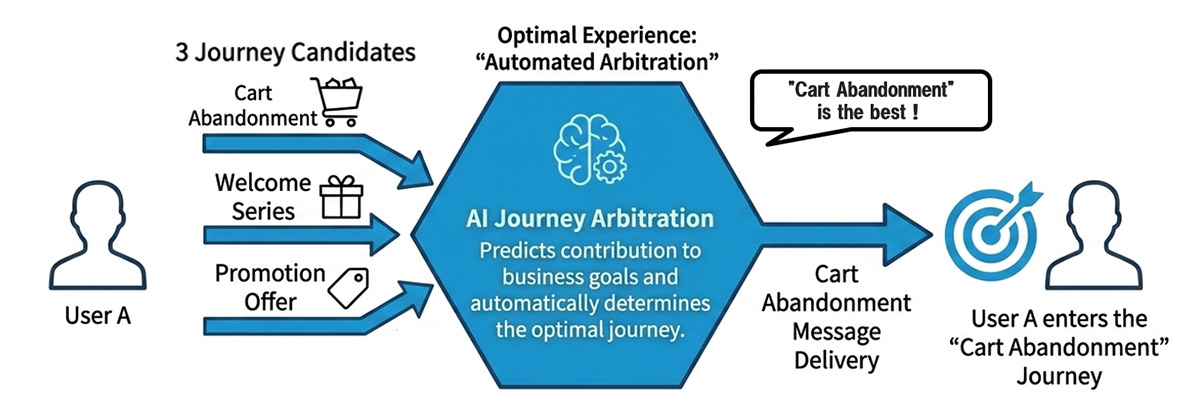
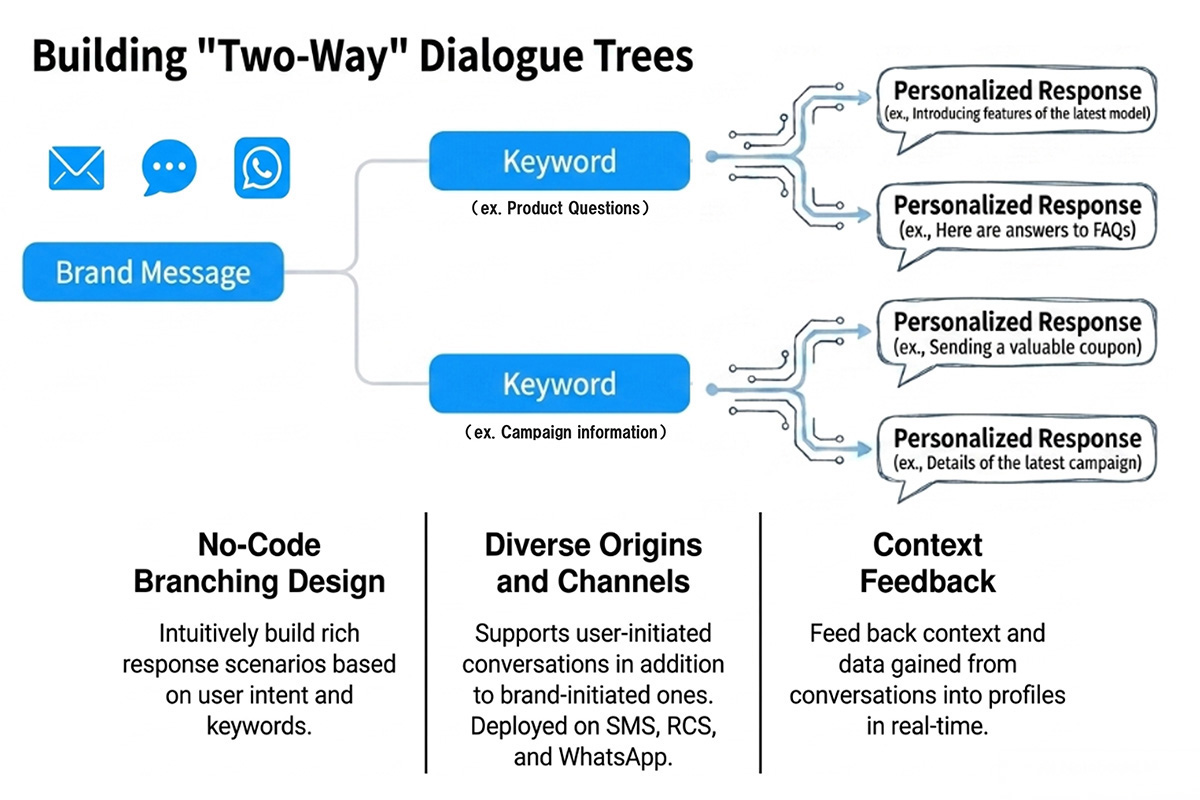
To further elevate personalization, two new features were introduced: AI Journey Arbitration and Conversation Designer.
AI Journey Arbitration is a feature designed for situations where a customer simultaneously qualifies for multiple marketing initiatives. AI automatically determines which experience or message will contribute most to business objectives, such as sales revenue, and routes the customer to the optimal journey accordingly.
Conversation Designer is a feature that allows marketers to visually design two-way conversations with customers via SMS or messaging apps. While conventional MA primarily revolved around one-way broadcasts such as emails or push notifications, this capability will roll out starting this summer with automated keyword responses, eventually evolving into autonomous AI agent interactions.
Furthermore, integrations with external tools will be released in rapid succession. Through MCP server integration, external AI tools like ChatGPT or Gemini will be able to directly access AJO data and operate within AJO. Additionally, Composable Content will allow marketers to dynamically ingest external CMS assets or real-time API data, such as weather or pricing, into messages without code.
Personally, the update with the greatest impact was the announcement of AJO Loyalty, a new product scheduled for general availability this August. Traditional loyalty programs have focused heavily on static point management, whereas AJO Loyalty uses a Loyalty Agent AI to analyze purchase histories and behavioral patterns and suggest the optimal next step for each customer. For example, if it detects members whose tier advancement has stalled, it can autonomously propose, “Let’s run this targeted campaign for them,” enabling execution directly through AJO. For marketers facing challenges with loyalty programs, this is a groundbreaking solution to watch closely.
The Power of Data Integration Learned from Global Case Studies and Its Application in Japan
—Were there any global case studies presented at the Summit that left a strong impression on you?
Kurai: A case study from a major sports organization was particularly insightful. Within that organization, approximately 30 individual club teams were managing their fan data independently. As a result, communications were fragmented and excessive, leading to customer fatigue. To resolve this, they consolidated scattered data across the league and clubs into a single platform, establishing a unified fan view across every touchpoint, including web, mobile, ticket sales, merchandise purchases, and live events. Using AI and automation tools, they created real-time, personalized customer journeys.
As a result, draft registrations increased by 91%, ticket conversions improved by 215%, and opt-outs decreased significantly*. This case clearly demonstrates that without unified data, even the most cutting-edge AI remains an untapped asset.
*Data presented at Adobe Summit 2026.

—Applying this example to the Japanese market, what strategy would you recommend?
Kurai: To achieve advanced, unified data-driven communication in the Japanese market, similar to this U.S. case study, the key lies in leveraging LINE. We believe that integrating LINE with AJO unlocks immense new opportunities. Just as the sports case study unified ticketing and merchandise data, in Japan, integrating LINE behavioral data and purchase data within AEP, or Adobe Experience Platform, and designing seamless customer experiences via AJO is highly effective.
Specifically, applying the concept of "Conversation Designer" to LINE allows brands to move away from one-way notifications and instead capture customer zero-party data through dialogue, feeding it back to AJO to deliver richer, personalized experiences.
Additionally, LINE serves as an ideal interface for AJO Loyalty. LINE is used daily by a vast user base in Japan, making it a natural touchpoint for customers to check their tier status or progress, such as “Only X more purchases to unlock rewards.” Delivering AI-driven optimal messages directly via LINE can significantly deepen customer engagement. In the AI era, designing how to connect LINE as a channel with AJO as the central brain will be indispensable.
Why "Professional Intervention" Is Necessary in the AI Era and What to Start Today
—How will the role of agencies be redefined in the era of Agentic AI?
Kurai: We view our role not merely as implementing or operating AI tools, but as professionals who intervene to maximize the tangible business value companies derive from them. Specifically, we deliver value across three core domains:
- Data Integration
Establishing clean, high-quality data and robust system architecture required for AI to make accurate decisions. This involves unifying fragmented customer, behavioral, and transactional data across the enterprise into AEP so AI can immediately act on it. - Brand Governance
Using Adobe Brand Intelligence to ensure that high-volume AI-generated content never compromises brand equity. As emphasized at Summit, this requires expertise in translating and structuring implicit brand knowledge—such as aesthetic judgment and the brand’s distinctive feel—into operational guardrails for AI. - Context Design
As interfaces transition to conversational models and tasks are delegated to AI, the quality of context—what to delegate, and under what circumstances—becomes the ultimate differentiator.
An agency’s core responsibility is to serve as the command tower, drawing strategic blueprints for what AI should accomplish and orchestrating multiple AI agents. At Dentsu Digital, specialists across all three domains collaborate to provide end-to-end support spanning strategy, orchestration, and creative governance.
—Finally, what should companies begin working on right this moment?
Kurai: You do not need to wait for the upcoming summer releases; there are actionable steps companies can take today.
The first step is data audit and integration planning. Mapping the current state of customer, behavioral, and transactional data siloed within your organization and establishing a consolidation roadmap is step one.
In parallel, redefining brand guidelines is highly effective. Structuring tacit brand knowledge into explicit formats that AI can process as decision-making rules will pay immediate dividends. Furthermore, optimizing brand visibility to ensure AI agents accurately recognize and reference your brand represents a critical new form of SEO for the AI era.
The era of agentic AI is already here. Let’s start with small pilot initiatives and move this transformation forward together.
For inquiries regarding this article, please contact us here.