

Next-Generation CX on a Global Scale: Customer Experience in the Age of AI Agents as Envisioned by Salesforce, Merkle, and Dentsu Digital
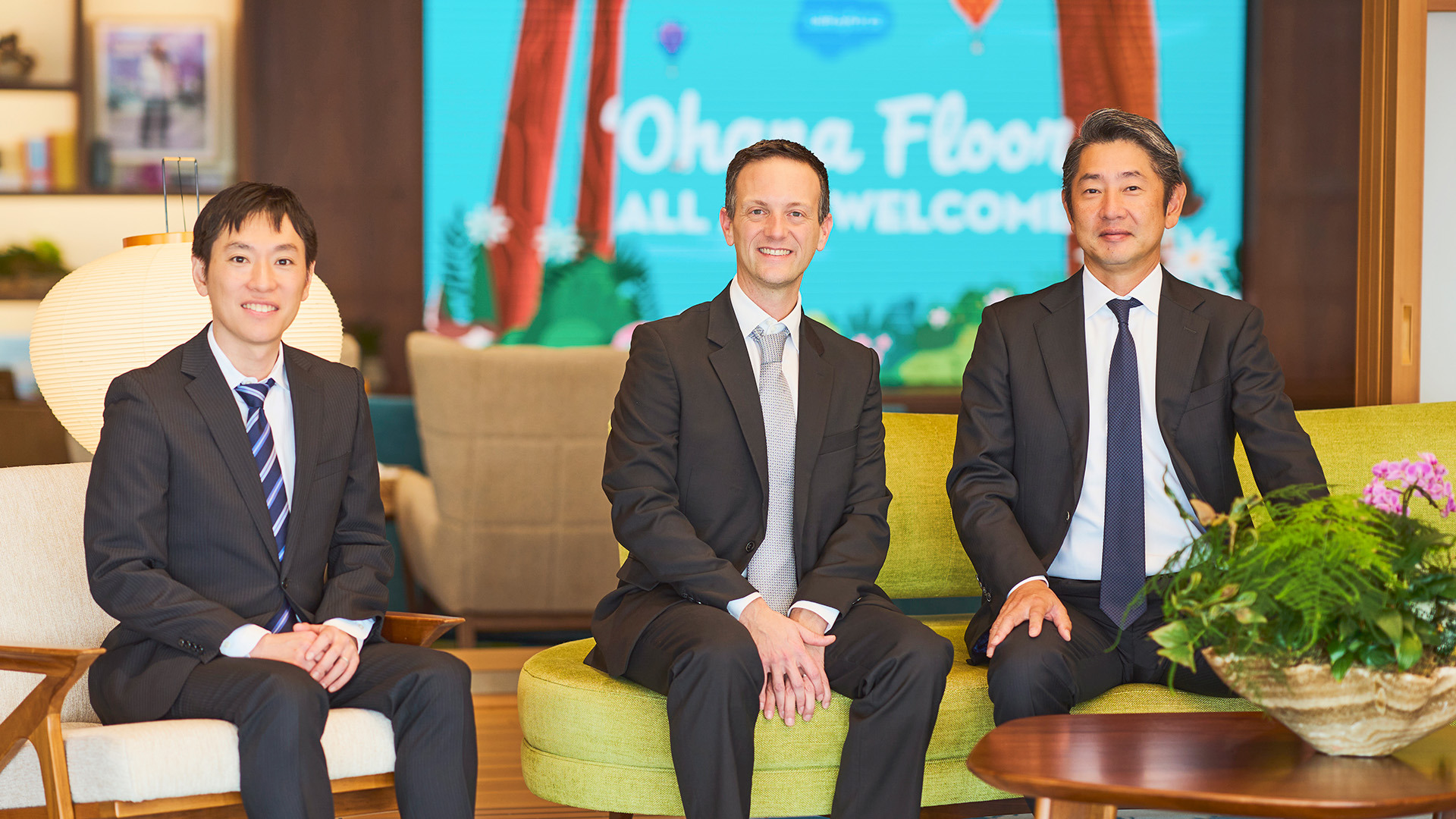
As the evolution of AI accelerates, Dentsu Digital is strengthening its strategic partnership with Salesforce and Merkle to create new value in customer experience (CXM) and employee experience (EX). By combining our strong domestic execution capabilities, the latest technologies from Salesforce, and Merkle’s global insights, we are taking on the challenges faced by Japanese companies, such as a declining population and the slow progress of digital transformation (DX). In this roundtable discussion, leaders from each company share their perspectives on business transformation through AI agents and envision the future of enterprises as the “Agentic Enterprise.”
Table of Contents
- Enhancing Customer Value Through a Unified Three-Partner Approach
- Exploring New Possibilities for CXM in the Era of Human-AI Collaboration
- Uncovering AI and CXM Challenges and Opportunities in the Japanese Market from a Global Perspective
- The Evolution of the Japanese Market and the “Ideal CXM” Created by AI and Co-Creation
Enhancing Customer Value Through a Unified Three-Partner Approach
Yusuke Okada (Dentsu Digital): A major strength of the collaboration among our three companies lies in the fact that, while we are part of a global network, we are rooted in Japan and possess deep and comprehensive capabilities tailored to the Japanese market. As a global network, dentsu(the Group) was recognized as a "Leader" for the second consecutive year, together with Merkle, in the 2025 Gartner® Magic Quadrant™ for Digital Experience Services, which evaluates companies providing digital customer experience services worldwide.
By combining Merkle’s global CXM network, the comprehensive customer experiences enabled by Salesforce Customer 360, and our own strengths, we have established a truly unique three-part structure. Leveraging the Salesforce platform to connect our Japan-based network with a globally expanding network creates a highly meaningful collaboration model, and I believe this will offer significant value moving forward.

Michel Mayor (Merkle): Our industry is changing at an unprecedented pace. While this presents tremendous opportunities for companies, it also brings numerous challenges. When a company tries to drive innovation on its own, it often faces significant obstacles such as high costs and a shortage of talent—and even the best solutions can quickly become outdated. That’s why I believe in the importance of strategic partnerships like ours. By complementing each other's strengths, the three companies can deliver optimal value to our clients. I am confident that this creates a true "Win-Win-Win" scenario for our clients, our partners, and the industry as a whole.
In addition, outside of Japan, Merkle has established itself as a top global Salesforce partner with over 20+ years of deep collaboration, amassing a wealth of knowledge, amassing a wealth of experience and already nurturing thousands of Agentforce professionals. We aim to rapidly deliver to our Japanese clients the global knowledge, use cases, and experience gained from overcoming challenges worldwide.

Atsushi Urano (Salesforce Japan): As we enter the era of the "Agentic Enterprise," we expect the total addressable market (TAM) to expand into the realm of business operations outsourcing, reaching an estimated scale of $13 trillion within the next few years. In such a vast market, the capabilities and strong client relationships that Dentsu Digital possesses are extremely important for supporting customers in the operations and CXM domains. Up to now, our collaboration has focused mainly within Japan, but I look forward to further enhancing our global cooperation and expanding our strategic partnership in the future.
Exploring New Possibilities for CXM in the Era of Human-AI Collaboration
Okada: AI agents are transformative technologies that impact not only customer experience (CXM) for consumers, but also employee experience (EX) within organizations. For consumers, AI agents are already enabling seamless access to information across various touchpoints and delivering highly personalized experiences optimized for each individual.
However, the true potential of AI lies in transforming complex business operations, such as sales and marketing. Moving forward, it will be crucial not only to enhance CXM, but also to expand and evolve overall business operations through AI.
Similarly, employee experience (EX) is an equally important focus. I believe that a major challenge in the future will be how to elevate the value of EX from both cultural and practical perspectives.
Mayor: Absolutely. Determining where humans should collaborate with AI agents and where responsibilities should be divided is a major challenge for the industry. Simply replacing human work with AI agents for the sake of cost reduction will not produce positive results for businesses, customers, or society as a whole.
AI agents play a key role in optimizing business processes and bridging operational gaps. By leveraging the expertise of not only Dentsu Digital, but also the broader Dentsu Group in Japan, we can create even greater value. In fact, many widely adopted AI agent solutions have resulted from such partnerships.
Urano: AI agents powerfully support organizations in achieving their goals, much like secretaries who think and take action independently. In Japan, where the population is aging and the labor force is shrinking, expectations for AI are rising. However, the complete automation of sophisticated customer communications through AI alone is not yet a realistic prospect. Our concept of the “Agentic Enterprise” positions AI not just as a tool for improving efficiency, but as a core driver of organizational transformation toward more creative ways of working.
At the foundation of this transformation are our CRM solutions, which hold a 20% global market share, and our customer data platform “Data 360,” an area we will continue to focus on in the future. These data assets are critical for AI agents to fully understand context and execute tasks accurately. Since the use of AI agents affects existing operations, it is essential to enable secure integration between large language models (LLMs) and enterprise data. In advancing these initiatives, a partnership with Dentsu Digital is extremely important.
Uncovering AI and CXM Challenges and Opportunities in the Japanese Market from a Global Perspective
Okada: From a global perspective, what challenges and unique characteristics do you see regarding AI utilization and customer experience (CXM) strategies among Japanese companies?
Urano: I believe Japanese companies face both technological challenges and structural issues unique to Japan. The greatest challenge is dealing with the declining population—in other words, how to achieve business growth amid a shrinking workforce. One possible solution to this is the adoption of autonomous AI agents, or Agentic AI.
Another challenge is that, although many large enterprises in Japan are working to introduce AI, there are still few cases where they have achieved significant results. We place great importance on supporting our clients to deliver tangible outcomes through the adoption of autonomous AI agents in collaboration with our partner companies.
Our approach focuses on carefully addressing any concerns and anxieties, and rather than pursuing traditional large-scale projects that can take a year or more, we prioritize short-term Proof of Concept (PoC) initiatives that last two weeks to a month. By accumulating small but clear “quick wins,” we build momentum. Once we identify areas where a positive ROI can be expected, we rapidly scale up from there. This is the approach we are putting into practice.
Mayor: I completely agree—speed is the key to success. Many companies move forward with AI projects simply because they believe they have to implement AI, but they often neglect the most fundamental question: “Why are we doing this?” The true value of our collaboration between Dentsu Digital, Salesforce, and Merkle lies in our ability to jointly define and clarify this “why.”

Mayor: Once the “why” is clearly defined, it becomes much easier to identify the “how”—the best way to execute. Delivering ROI in a short period of time is also crucial for steadily advancing Agentforce initiatives and driving AI transformation.
Okada: I couldn't agree more. Clearly defining the fundamental question of “why” is the first step to success. Of course, execution—“how”—is important, but once the purpose is well defined, the path to success becomes much clearer. With the combined strengths of our three companies, we can work alongside our clients to identify the optimal approach, clarifying the “why” together on the journey toward success.
The Evolution of the Japanese Market and the “Ideal CXM” Created by AI and Co-Creation
Okada: Japanese companies are facing a variety of challenges, including a declining population, labor shortages, and changes in work styles. In overcoming these challenges, what kinds of value do you think can be provided through "global × local" collaboration, such as that between Merkle and dentsu?
Mayor: One of dentsu's strengths is its ability to collaborate on a global scale. For example, at Omega, our dentsu hub in Spain, we are undertaking advanced initiatives utilizing Agentforce, and we are sharing this expertise with various markets—including Japan—through workshops and enablement programs. While it’s not possible to simply copy local cultures or needs, we can create new value by applying global insights at the local level. By combining Dentsu Digital’s deep understanding of the Japanese market with Merkle’s global expertise, I believe we can drive transformation that goes beyond solving challenges and set a new standard for customer experience (CXM).
Okada: At present, we are already seeing concrete collaborations take shape. For example, there are projects where Dentsu Digital is responsible for client engagement and project management, while implementation is carried out using Merkle's development capabilities. Conversely, we are also seeing more proposals from the Merkle side to handle client relationships themselves by leveraging Dentsu Digital’s resources. These seeds of collaboration are gradually coming to fruition, and we are steadily building an environment where insights gained globally can be transferred to the Japanese market. Moving forward, we aim to further expand such initiatives.
Okada: Based on what we have discussed so far, I’d like to ask both of you — what is your vision of an “ideal” customer experience (CXM)?
Urano: What comes closest to our vision of the ideal is the concept of the “Agentic Enterprise.” At Salesforce, we place great importance on the concept of “Customer Zero,” which means becoming our own first customer. In fact, we are actively promoting the Agentic Enterprise model within our organization, continuously refining and improving the model in real time and building up our own success stories. We hope to share these real-world examples and results with our clients, and to drive this transformation together with our partners.
Mayor: If Salesforce is “Customer Zero,” we position ourselves as “Customer One.” In practice, we have already implemented use cases for Agentforce within dentsu. One example is our global agent “Trailblazer Scout,” which helps us identify the best talent based on certifications and experience. Another is our in-house SDR Agent, which we plan to introduce at the Agentforce World Tour in London. In this way, we are also learning from Salesforce and moving in the same direction.
Through this collaboration, I am convinced that we can create long-term value centered around Agentforce. I am confident that, together, we can become more than just partners—we can deliver real impact for our clients.
Okada: What I’ve come to realize once again through this discussion is that AI agents are becoming an extremely important presence for companies. AI agents are more than just tools—they serve as enablers of organizational growth, disruptors of transformation, and even as partners or “buddies” for people. However, simply implementing them is not enough to realize their true value. Just as important as the technology itself are our own ability to put it into practice and our operational expertise.
Looking ahead, I believe we can drive truly effective transformation by leveraging the scale and comprehensive strengths that Salesforce, Merkle, and Dentsu Digital bring together, while maintaining a strong focus on practical, on-the-ground deployment—how we use and operate these technologies. Rather than having unrealistic expectations of technology alone, we aim to generate real value for our clients through continuous operational improvement and the accumulation of knowledge and experience in AI utilization.
For inquiries regarding this article, please contact us here.